
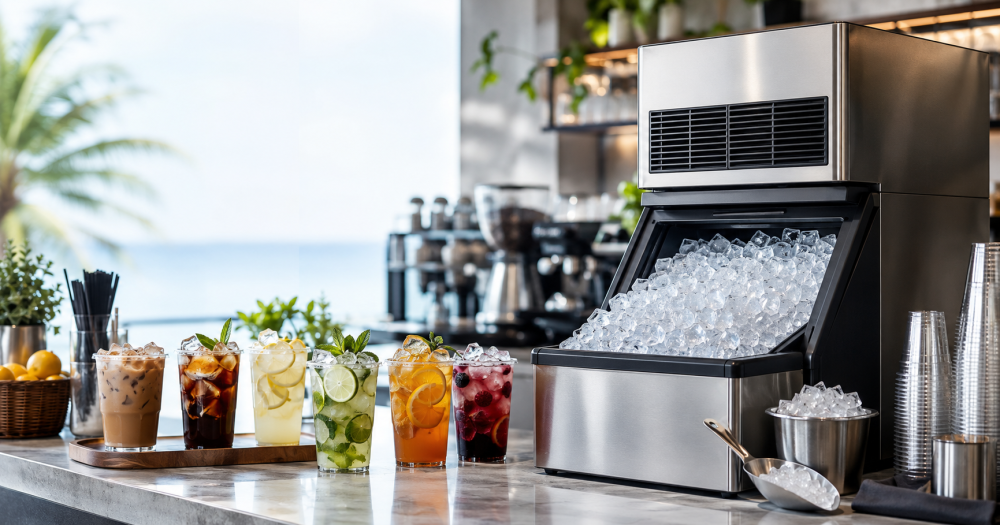
The coffee shop may run out, so you can open a new pack in seconds, and the syrup may run out, so you can replace it with another flavor, but when the ice runs out in the middle of peak summer hours, an entire menu of drinks almost stops.
Suddenly, iced lattes, mojitos, frappes, and smoothies can't be made, and the temporary solution becomes buying ice packs from outside at a higher cost and potentially subpar quality. This highlights that an ice machine isn't a secondary piece of equipment for a café, but rather a fundamental component of the business's ability to continue selling.
The problem is that choosing an ice machine for cafes isn't simply about buying the biggest machine available or just looking at the price. The right choice starts with calculating the number of cold drinks, the amount of ice per cup, peak hours, the operating temperature, and the ice storage capacity.
This guide explains how to determine the appropriate capacity for a commercial ice maker, the key differences between production and storage, and the factors to check before preparing your summer drinks menu.
Why is an ice machine essential in a cafe during the summer?
The demand for cold drinks increases in hot weather, especially in the Saudi market, where many cafes rely on iced coffee, cold matcha, frappes, smoothies and refreshing drinks as part of their core products.
A lack of ice leads to more than just a delay in order; the cafe may be forced to stop selling drinks with a good profit margin, or to use less ice, which changes the drink's appearance, concentration, and temperature.
Having a suitable ice cube machine helps to:
- Orders continue to be prepared during peak hours.
- Maintaining consistency in beverage recipes.
- Reduce reliance on ready-made ice.
- Controlling water quality and ice cleanliness.
- Improving customer service speed.
- Supporting the expansion of the summer drinks menu.
Therefore, choosing an ice maker should be approached in the same way as choosing an espresso machine or a professional blender, based on the actual operating volume and not just the price.
What is the difference between production capacity and storage capacity?
One of the most important things to understand before buying an ice machine for a cafe is the difference between the daily production quantity and the internal container capacity.
production capacity
It is the amount of ice that the machine can produce in 24 hours under specific operating conditions, and is often measured in kilograms per day.
When the manufacturer states that the machine produces 30 kg per day, this does not mean that 30 kg will be ready inside it at the same moment, but rather that it can produce this quantity gradually throughout the day.
storage capacity
This refers to the amount of ice the container can hold at one time. A machine might produce 30 kg per day, while its internal storage capacity is only 8 or 10 kg.
When the container is full, the machine typically stops production until some of the ice is used. Therefore, the daily capacity may be adequate, while the container is small relative to the demand for ice over a short period.
When comparing ice machines, always check these two numbers: production in 24 hours and storage bin capacity .
How do you calculate a cafe's daily ice requirement?
There is no single capacity suitable for all cafes. A practical estimate can be obtained using the following equation:
Number of cold drinks per day × Average amount of ice in the drink + Safety margin = Approximate daily requirement
First step: Calculate the number of cold drinks
Do not rely on the total number of customers, as some of them will order hot drinks or products that do not require ice.
Review the sales data if the cafe is operating, and determine the average number of cold drinks during regular days and weekends.
When launching a new project, three expectations can be made:
- Low demand during startup.
- Average demand during normal days.
- High demand in the summer and on weekends.
Machine selection should be based on the average scenario with the ability to cover the peak, not on the lowest possible forecast.
Step two: Determine the amount of ice in each volume.
Weigh the actual amount of ice used in each glass instead of guessing. A small glass may require a completely different amount than a large one, and the amount of ice will vary between iced lattes, frappes, and smoothies.
For example, if the average consumption per drink is 200 grams of ice, and the cafe sells 100 cold drinks per day, the basic requirement becomes:
100 x 200 grams = 20 kg of ice per day.
Step three: Add a safety margin
Do not choose a machine that produces exactly the calculated requirement. Add an estimated margin of 20% to 30% to cover:
- High demand in the summer.
- The amount of ice varied among the employees.
- Large and unexpected orders.
- Using ice for cooling or display.
- Production declined due to the heat of the place or the water.
- Expected sales growth.
In the previous example, if the basic requirement was 20 kg, adding a 25% margin would increase the required capacity to approximately 25 kg per day. It is preferable to choose the slightly higher category rather than running the machine at full capacity all day.
Don't rely solely on the number of customers.
Two cafes may receive the same number of customers daily, yet each requires a completely different capacity.
The first café might focus on espresso and hot drip coffee, while the second concentrates on frappes, mojitos, and cold matcha. Therefore, the sales mix should be analyzed , not just the number of visitors.
The proportion of takeout and delivery orders should also be considered. Large cups and group orders can consume a significant amount of ice in a short period, even if the number of people seated inside the cafe is limited.
How do cup sizes affect capacity selection?
The larger the cup, the more ice is typically used. If the cafe offers three sizes, it's a mistake to calculate all orders based on a single size.
The weighted average can be calculated in this way:
- Determine the sales percentage for each volume.
- Weigh the amount of ice for each size.
- Multiply the ratio by the amount of ice.
- Combine the results to arrive at an average that is closer to reality.
If the majority of sales are of large size, a small machine will not be suitable even if the number of daily orders seems low.
Properly measuring the amount of ice in standard recipes helps reduce waste. A clear weight or filling level should be specified for each cup, and baristas should be trained accordingly instead of using arbitrary quantities.
The effect of temperature on ice-making machine production
The production capacity of ice machines is usually measured under specific test conditions, and actual production may vary when the ambient air temperature or the temperature of the water entering the machine increases.
This point is particularly important in kitchens and small or poorly ventilated spaces. A machine placed next to an oven or other heat source may not achieve its advertised capacity.
To maintain production efficiency:
- Place the machine in a well-ventilated location.
- Leave the ventilation spaces specified by the manufacturer.
- Keep it away from ovens and direct sunlight.
- Do not close the air intake and exhaust vents.
- Make sure the water reaches a suitable temperature.
- Clean the condenser and filters regularly.
In hot weather, the margin of safety in capacity becomes more important, because relying on nominal power alone may lead to a shortage of ice at peak times.
What is the best shape of ice for cafe drinks?
Not all ice cubes are the same in terms of how they are used or how quickly they melt. Therefore, the shape should be chosen according to the beverage menu.
perfect cubes
Suitable for iced lattes, iced Americanos, and soft drinks. It often features a slower melting time, which helps maintain the drink's concentration.
small cubes
The drink cools down quickly and is suitable for some juices and mojitos, but it may melt more quickly depending on its size and density.
crushed ice
It is used in slushies and some refreshing drinks, but it requires a dedicated machine or tool, and may not be suitable for all types of cold brew coffee.
Crescent or half-cube ice
It is easy to distribute inside cups and can be suitable for quick operation, but the final choice depends on the presentation style and the type of device available.
Before purchasing the machine, test the shape of the cube inside the cups used in the cafe and make sure it is suitable for the straws, lids and recipes.
Is it a compact machine or a separate machine with a container?
Compact machine
The production unit and storage container are combined into a single device, typically suitable for small cafes or limited spaces. Its advantages include ease of installation and compact size, but its storage capacity may be limited.
separate machine
It consists of a production head placed on top of a separate container, and is suitable for high-consumption projects. A larger container is available, but requires additional space, installation, and equipment.
Do not choose the type based solely on the shape of the device; rather, compare the site area, peak hours, amount of storage required, and the possibility of future expansion.
Other factors to check before buying
Water quality and filtration system
Water is the primary component of ice. Its quality affects the clarity of the cubes, the taste of the drinks, and the buildup of deposits inside the machine.
Installing a suitable water filter helps improve ice quality and reduce sediment, but it does not eliminate the need for cleaning and maintenance.
Electricity and water consumption
Compare the efficiency of different models, especially if the machine will be running all day. A lower purchase price doesn't always mean lower running costs in the long run.
Easy to clean
Choose an ice maker with easily accessible internal parts and a clear cleaning program or instructions. Ice is a food product, and the container, scoop, and internal surfaces must be handled according to hygiene standards.
Maintenance and spare parts are available.
Check the warranty, after-sales service, and spare parts availability within Saudi Arabia. Ice machine downtime during the summer can directly impact sales, so prompt maintenance is crucial.
Device dimensions and installation requirements
Measure the space before purchasing, and ensure there is access to water, drainage, electricity, and ventilation. Don't rely solely on external dimensions; the appliance may require additional space around it.
Common mistakes when choosing an ice machine for cafes
The most common mistake is choosing capacity based on price, then discovering that production does not cover peak hours.
Other mistakes include confusing production capacity with storage capacity, ignoring high temperatures, or failing to account for ice used in blenders and large drinks.
Similarly, a business owner might purchase a machine that is too large for actual needs, thus taking up space and increasing purchase and operating costs. The solution is not always to buy the largest, but rather to choose a capacity that achieves a balance between expected demand and a safety margin.
Choose your project equipment with the luxury of coffee
Choosing the right ice machine helps you serve summer drinks consistently and quickly, but it remains part of an integrated equipment system that includes blenders, refrigerators, barista tools, specialty coffee, matcha, syrups, sauces and drink mixes.
Coffee Luxury provides a diverse range of cafe equipment and beverage supplies for projects in Saudi Arabia, with solutions to suit new cafes and existing projects that wish to develop their operational capabilities.
By determining the number of your daily drinks, cup sizes, and the type of ice required, you can choose an ice maker that suits your project's needs instead of buying a machine that is less than required or paying for a capacity you will not use.
Browse the cafe equipment and beverage supplies options at Coffee Luxury, and equip your business with tools that help you keep up with the summer heat and deliver a consistent experience for your customers.
Frequently asked questions about choosing an ice machine for cafes
What is the appropriate capacity for an ice machine in a small cafe?
The capacity depends on the number of drinks and the amount of ice in each cup. If a café sells around 100 cold drinks and uses 200 grams of ice per drink, it might need a basic 20 kg capacity, but it's preferable to choose a capacity of approximately 25 to 30 kg after adding a safety margin.
Is daily production the same as storage capacity?
No. Daily production is the amount of ice the machine makes in 24 hours, while storage capacity is the amount of ice the container can hold at the same moment.
Does the efficiency of an ice machine decrease in the summer?
Actual production may decrease if the ambient or water temperature is high, especially with poor ventilation. Therefore, the machine should be installed away from heat sources, and a suitable margin should be added when calculating capacity.
What is the best shape of ice for iced coffee?
Whole or solid cubes are often used because they melt relatively more slowly, helping to maintain the coffee's strength. However, the choice also depends on the shape of the cups and the serving method.
Does an ice machine need a water filter?
Using a filtration system suitable for the on-site water quality is recommended, as it helps improve the taste of the ice and reduce sediment buildup inside the machine. Filters should be changed and the machine cleaned according to the specified schedule.
Where should the ice machine be placed inside the cafe?
It should be placed near the cold beverage station, in a well-ventilated location, away from ovens, sunlight and heat sources, with access to water, drainage, electricity and the necessary distances for maintenance.
Should I choose a machine with a capacity equal to my daily consumption?
It is best to choose a capacity that is approximately 20% to 30% higher than the basic need, in order to cover the summer peak, the potential decline in production, and the growth in sales.
How often should the ice machine be cleaned?
The container, scoop, and surfaces in use must be cleaned continuously, and periodic cleaning and sterilization must be carried out according to the manufacturer's instructions, with monitoring of the filters, condenser, and water quality.